
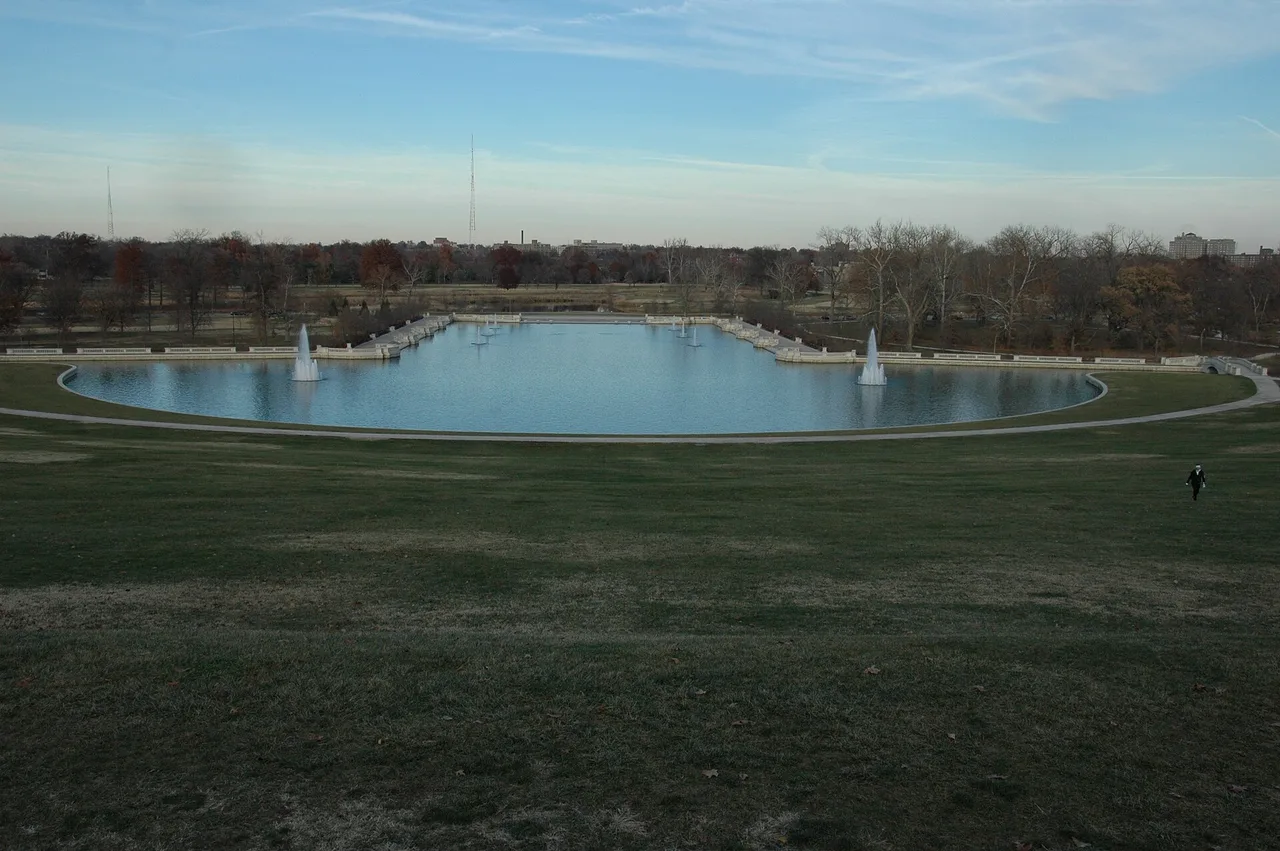
Forest Park opened in 1876 on what was then the western edge of St. Louis. It covers about 1,371 acres. The useful box is Skinker on the west, Lindell on the north, Kingshighway on the east, and I-64 on the south.
The 1904 World's Fair used about 1,200 acres of the western park. About 1,500 buildings went up in staff, a plaster mix meant to last a season. Most of them came down. Two structures were built to stay: the Palace of Fine Arts, now the Saint Louis Art Museum on Art Hill, and the Flight Cage, a Smithsonian aviary that helped anchor the Saint Louis Zoo when the zoo developed here in 1913. The statue of St. Louis on Art Hill also survives from the fair.
The Municipal Theatre Association, the Muny, first performed in 1919 and still runs outdoor musicals in summer. The Missouri History Museum sits in the Jefferson Memorial on the north side of the park. The Saint Louis Science Center sits on the Oakland edge. The Grand Basin is the water at the foot of Art Hill. You can walk from the art museum to the zoo to the History Museum in one afternoon.
The Central West End sits on the east edge. Skinker-DeBaliviere and the Delmar Loop sit on the west. Dogtown and The Hill sit south of I-64. "Near Forest Park" on a listing only means something if you can name the gate.
Why people stay
- The zoo, the art museum, and the paths are a weekday habit.
- Core attractions are free, which makes hosting guests simple.
- CWE, Skinker-DeBaliviere, and Dogtown each give you a different walk to the same park.
- The Muny in summer is a night you can do from the neighborhood.
- The park is 1,371 acres. You pick a gate and use that corner.
Homes here
Homes for sale St. Louis around Forest Park live in those edge neighborhoods. Homes for sale Skinker DeBaliviere and Dogtown St. Louis homes for sale are two of those edges. A St. Louis realtor will ask which gate you would actually use. The city neighborhood guide maps CWE, Dogtown, and the west side.